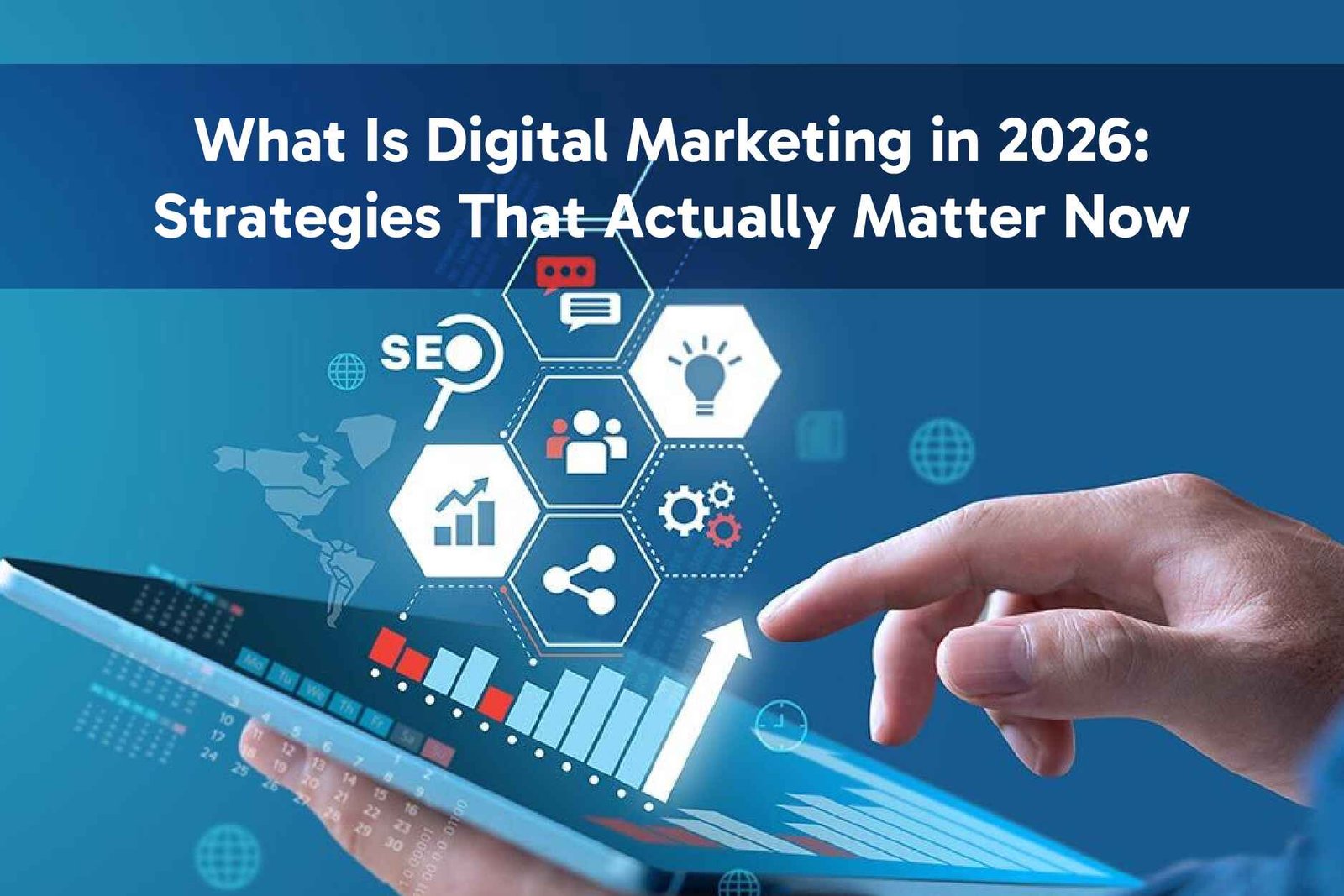




If you ask ten individuals what is digital marketing, you will most likely get ten different responses. Social media could be the first area of discussion, and Google Ads the second area. A few people might even consider speaking about SEO, email, or influencer marketing. To some level, all of them are right, but at the same time, none of them narrates the whole story.
It is a completely different picture of digital marketing in 2026 as compared to that of five years ago. The means have metamorphosed. The places to conduct business have become more extensive and more sophisticated over the years. The customers have undergone a transformation process that made them more selective, faster, and harder to satisfy than ever before. The once-thriving tactics may not be useful in the current climate.
Consequently, instead of repeating the definitions given online, we would rather spend a considerable amount of time elucidating what is digital marketing today in terms of the ways it operates, its progress, the features that are still significant and the areas where businesses should direct their marketing efforts in the future.
What is Digital Marketing?
Digital marketing is primarily the method through which brands get to the public using digital means. The digital channels consist of websites, search engines, social media, email, apps, and even chats.
However, the main aspect of what is digital marketing is not only about platforms but also how companies appear online and how they gain attention rather than interrupting it.
In the present time, digital marketing is no longer about broadcasting messages but rather:
- Being present when people look for you
- Being supportive when people seek information
- Being memorable when people are weighing different options
To sum it up, it is not merely marketing on the internet; rather, it is user-behavior-oriented marketing.
What Do You Know About Digital Marketing Today vs. Then
A decade ago, digital marketing was simpler. You could:
- Run ads with broad targeting
- The days of publishing short blogs just to attract search engines are over.
- Grow social pages by posting often, not necessarily well.
That era is gone.
What’s your knowledge of What Is digital marketing at this time? It has become more fragmented, and also more competitive and more accountable. The tracking of clicks, scrolls and conversions is done for every single person. Relevance is being rewarded by the algorithms, not the volume. Very easily, the audience will just scroll past anything that doesn’t feel real or that is forced.
Marketers now have to balance:
- Creativity and data
- Speed and consistency
- Automation and human voice
This shift has reshaped how strategies are built.
Digital Marketing Basics Still Matter (More Than Ever)
The digital marketing basics might be forgotten due to the emergence of new tools and trends, but they still serve as the main building blocks.
There are still no changes to the following things:
- A slow-loading website continues to lose users
- Bad messaging confuses people still
- Content that is not relevant is still not read
Although search engines have become more intelligent, they still give preference to clear communication. Social media might transform, but transparency and usefulness will still attract people’s reactions.
The solid foundation of What Is digital marketing in 2026 will still be:
- Unambiguous positioning (who your target is and why)
- Brand voice present on all platforms and in a consistent manner
- Content that addresses genuine inquiries
- User journeys that are easy and not annoying
Above all, the best instruments will not be able to do anything for a campaign without these.
What’s Actually Changed in Digital Marketing
Let’s discuss the actual shifts rather than only the novelties.
1. Search Is No Longer Just About Keywords
The search engines have recognized the user’s intention as their main priority. It is no longer sufficient just to be listed for a term. Your content has to provide the answer to the query.
This affects:
- Blogging pattern
- Website depth
- Content standard
Content that is not helpful gets buried quickly, while content that is helpful remains available.
2. Social Media Is Pay-to-Play (Mostly)
There is still organic reach, but it is limited. Companies are now using social media for:
- Community building
- Brand awareness
- Trust signals
And not for immediate sales.
3. Content Has a Longer Job
Content is no longer only for attracting visitors. It also helps:
- Sales teams
- Email campaigns
- Retargeting ads
- Customer education
Quality content is effective in many areas.
4. Data Privacy Changed Targeting
With privacy laws and cookie changes, marketers rely less on third-party data and more on:
- First-party data
- Email lists
- Owned platforms
This made trust more valuable than tricks.
Digital Marketing for Website Growth
A digital marketing technique has become a necessity for website success, which is no longer the case for the website being just a digital brochure. The communication of the website through the internet means:
- The clear and user-friendly organization of the pages
- The production of writing that suggests the user’s choice
- The elimination of confusion at every stage
Marketing directed at the wrong audience is worthless. The aim is to draw the attention of the users who are searching for answers, products, or solutions. This is the point where SEO, UX, content, and analytics are united.
Digital Marketing for Technology Companies
What Is Digital marketing for tech brands presents its very own difficulties. The tech consumer group is:
- More informed
- More skeptical
- Less impressed by hype
They don’t want advance words. They want clarity.
What is more effective in digital marketing for technology:
- Straightforward explanations rather than dazzling promises
- Actual use cases instead of generic features
- Educational content that develops expertise
This is especially accurate for IT services, SaaS platforms, and businesses focused on solutions.
If you’re considering customized Digital Marketing Services for tech-dependent companies, the strategy should be based on real user requirements rather than following trends.
Digital Marketing for Marketers in 2026
Digital marketing for marketers today is equivalent to wearing multiple hats. You’re no longer just a content writer or ad manager. You’re also partly an analyst, a strategist, and a communicator. The focus of the successful marketer nowadays is on:
- Consistency across channels
- Counting what really matters (and not vanity metrics)
- Assuming outcomes instead of testing ideas
It is not “set and forget” with campaigns. They are continuously monitored, refined, and adjusted.
What Still Works Even After All the Changes
Even though everything has changed, some things still work great.
Helpful Content
Content that really helps always comes on top. Tutorials, explainers, comparisons, and insights get more engagement than advertisement fluff.
Email (Done Right)
Email is not dead. It is the spammy email that is not. Personal, relevant communication still gets the conversions.
Search Visibility
If you are not easy to find, then you are invisible. SEO is now taking longer to deliver, but it is more reliable in the long run.
Clear Messaging
If users do not grasp your message within five seconds, they leave the site. Simplicity is the virtue that is always in the right.
The Role of Digital Marketing Blogs
Digital marketing blogs aren’t just content machines anymore. They’re trust builders. Strong blogs:
- Be it customer questions or not
- Show your knowledge, but do not go overboard
- Help in making the traffic consistent
The best-performing digital marketing blogs feel like conversations, not lectures.
Where Businesses Often Get It Wrong
Came across the same old common mistakes again:
- Chasing every new platform
- Publishing content without a goal
- Only counting likes or clicks as success
- Not caring about the experience of users
What Is Digital marketing is at its best when it is concentrated and not scattered.
To Summarize
In 2026, digital marketing is a very different phenomenon. It’s a process that not only permits you to connect with the customers at the right moments but also pulls them in through realistic means up to a certain degree.
Realizing the changes that have occurred will stop you from employing techniques that are no longer valid. Being aware of the practices that remain effective will ensure that your business is based on a solid foundation. So, it is advisable to constantly go back to the marketing basics to keep your business’s communication grounded.
Digital marketing is not about being present across all channels. It is rather being able to deliver value through your presence in those digital channels that cater to your target audience, at the right time. And that is the way things are going currently, not just right now but also in the near future.
Frequently Asked Questions (FAQs)
What is the future of digital marketing in the next 10 years?
Digital marketing is here to stay; it just won’t be a separate thing. It will be part of everything. There will be more automation, but at the same time, there will be continuous pressure to be more human. The next ten years will bring:
- Smarter personalization, not just ads following you around
- Clicks are not the first priority, but rather the user’s intent.
- The noise will be disregarded, and relevance will be at the forefront.
- The burden of technology will be shared as humans will take over the strategy and creativity part.
Marketing will be perceived less as “marketing” and more as solving issues.
Is digital marketing a good career in 2025?
Yes. Still is. But it’s not the easy shortcut people sell on social media. In 2025:
- Skills matter more than degrees
- Portfolios beat certificates alone
- Generalists struggle, specialists grow faster
If you keep learning and don’t rely on one platform or tactic, it’s a solid career path.
How much will digital marketing be worth in 2030?
According to current estimates, it is going to be approximately $1.5 trillion worldwide by the year 2030. The mentioned growth is not attributed only to ads, but it also encompasses:
- Automation tools
- Data platforms
- Content ecosystems
- Performance marketing and analytics
Money follows the attention, and the attention is still online.
What is digital marketing look like in 2025?
In a way, it is changing already in the year 2025:
- AI is managing personalisation without showing up
- Voice and search intent are of higher importance than keywords
- Brands that feel real outperform brands that feel loud
Less of the show. More of the utility. More of the alignment between people’s needs and the offerings of businesses.