








5 years seems like a long time. Until it isn’t.
Look back 5 years and reflect on where you were then.In all likelihood life is a bit different today. Maybe you’ve got a new role, started a sideline venture, shifted to another city or picked up those sharp new skills you honestly didn’t expect to learn.
So, what could the next 5 years feel like if you were actually deliberate about it? That’s why I began to develop a 5 year plan example for myself.
Not because I did not wish to have all my future plans drawn up. It’s not how life works. Rather, i needed direction that was clear. A reminder to me each couple of months that I was still progressing towards the life that I wanted.
What was the greatest lesson I learned?
It’s mostly about laying out a direction, but also being open to change when life does what it does.
So, if you’ve ever wondered like, how can I even build a 5 year plan, this guide is meant to walk you through the steps that have worked for so many pros, entrepreneurs, and also students who want to keep their attention on what matters.
What Are Five Year Plans?
In a straightforward way, what do five year plans really mean?
A 5-Year Plan is a written document where you spell out the personal or professional aims you want to reach over the next 5 years. It’s not only about staring at the final destination, it also looks at the middle moves, the path in between.
It can include goals related to:
- Career
- Business
- Education
- Health
- Finances
- Relationships
- Personal Growth
The concept is not to manage all the outcomes.
It’s to do the right thing today that will benefit tomorrow.
The findings, published by the American Psychological Association, found that those who record their goals and periodically check in on their progress are more likely to stick to them than people who don’t write them down.
Why I Decided to Create a Five-Year Plan
Some years ago I noticed that I was always “busy”. However, I wasn’t always making progress. Each week was a productive one. Emails were answered. Projects were completed. I had a lot of meetings scheduled.
However, on reflection, I don’t remember if I was able to clearly articulate where all that work was going. It was at that moment that I noticed something was important. Being busy isn’t the same as moving forward.
As I was formulating my plan I had to ask myself questions I didn’t want to ask.
Questions like:
- Where Do I Actually Want My Career To Go?
- What Skills Will Matter Five Years From Now?
- What Kind Of Lifestyle Am I Working Toward?
- What Financial Goals Matter Most?
Those answers became the foundation of my plan.
Start With Your “Why”
Many people begin by writing goals.
I think that’s backwards.
Start with your reason.
If you don’t have the drive to accomplish them, your goals may not stand up to your busy schedule, obstacles, or unexpected difficulties.
For example:
Instead of writing:
“I want a promotion.”
Ask yourself why.
Maybe you want:
- More Financial Stability
- Leadership Experience
- Better Work-Life Balance
- Opportunities To Mentor Others
It is the answers that really matter more than the promotion itself , kind of. When you slip on motivation, your “why” turns into the actual fuel, the reason for continuing.
Choose the Areas That Matter Most
The first time I tried, I was doing everything at once, but it was not, you know, the right approach. That doesn’t hold up. Instead I tried to focus on four areas, just four.
Career
Consider what career path you would like to pursue.
Ask yourself:
- What Position Do I Want?
- Which Skills Should I Build?
- What Experience Am I Missing?
Finances
Money isn’t everything.
But financial freedom creates options.
Your goals might include:
- Building An Emergency Fund
- Paying Off Debt
- Buying A Home
- Starting A Business
- Investing For Retirement
Health
Success becomes much harder without good health.
Your five-year plan could include:
- Regular Exercise
- Better Nutrition
- Improved Mental Well-Being
- Better Sleep Habits
Small improvements here often make every other goal easier.
Personal Growth
Some goals aren’t about money or careers.
Maybe you want to:
- Learn A New Language
- Read More Books
- Travel Abroad
- Build Better Relationships
- Volunteer In Your Community
Those goals deserve space too.
A balanced plan usually lasts longer than one focused only on work.
How to Create a 5 Year Plan That You Can Actually Follow
Now comes the practical part. Here’s the process I still use today.
Step 1: Write the Big Goal
Start with the end result.
For example:
“I want to become a Marketing Manager.”
Or:
“I want to launch my own online business.”
Don’t worry about the details yet.
Just define the destination.
Step 2: Work Backwards
After you have determined where you want to be, consider the following:
“What needs to happen before that?”
If you are aiming for a management position, you may want to add:
- Gain Leadership Experience
- Complete Industry Certifications
- Improve Public Speaking
- Build A Professional Network
When you work on the big goal from the back, sort of feels like it’s easier to accomplish. It seems not as scary, at least for me, like.
Step 3: Turn Goals Into SMART Goals
The top reason people give up on long-term plans is they are too generalized, somewhat fuzzy, or not specific enough.
Instead of saying:
“I want to save money.”
Write:
“I will save $15,000 over the next 3 years by having $420 automatically taken from my bank account and deposited into my savings account each month.”
Notice the difference? Specific goals are easier to measure. And easier goals are easier to accomplish.
My 5 Year Plan Example
Here’s a simplified 5 year plan template business example based on career growth.
Year 1
- Complete Two Professional Certifications
- Build A Personal Portfolio
- Attend Industry Networking Events
Year 2
- Lead Larger Projects
- Improve Presentation Skills
- Find A Mentor
Year 3
- Apply For Leadership Roles
- Expand Professional Network
- Develop Management Skills
Year 4
- Manage A Team
- Increase Industry Visibility
- Speak At Professional Events
Year 5
- Move Into A Senior Leadership Position
- Mentor Junior Professionals
- Continue Learning Through Advanced Training
Notice something? Each year builds naturally on the previous one. Instead of chasing random opportunities, every step moves toward the same destination.
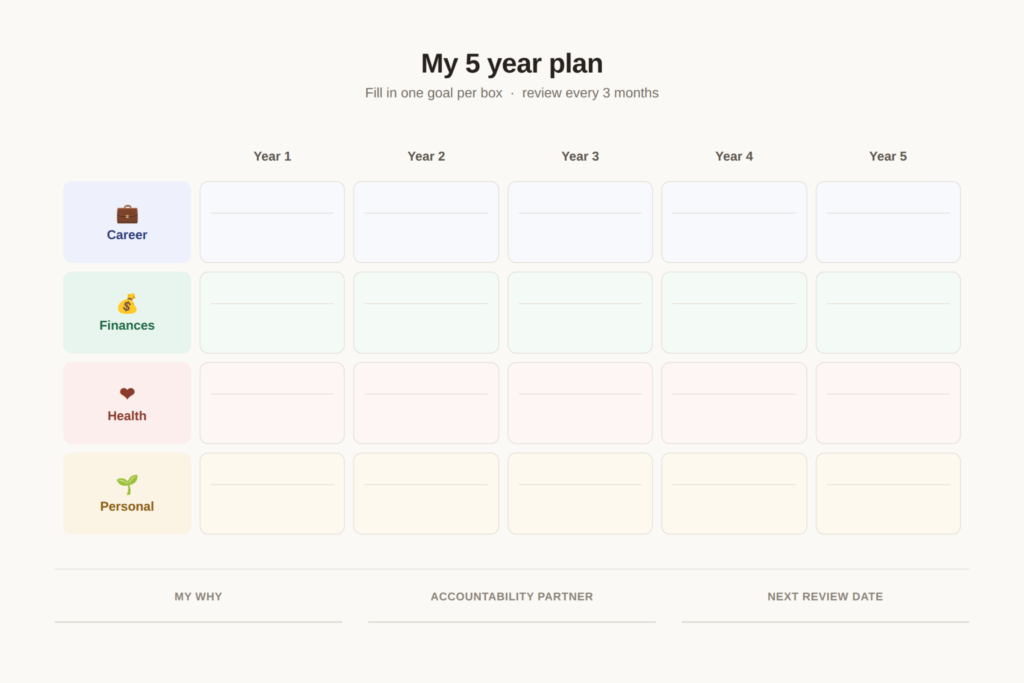
Use a Five Year Plan Template
Don’t Forget to Break Big Goals Into Smaller Ones
One thing I’ve learned is this: Big goals look exciting. Daily actions create results. It’s easy to say:
“I want to start my own business.”
But that’s not something you complete in one weekend. Break it into smaller milestones.
For example:
Year 1
- Research The Market
- Learn Basic Business Skills
- Build A Financial Plan
Year 2
- Launch A Website
- Find Your First Customers
- Test Products Or Services
Year 3
- Increase Revenue
- Build A Team
- Improve Operations
It is easier to feel like you are making progress, rather than feeling overwhelmed when you concentrate on each step one at a time.
Make Time to Review Your Plan
Creating a plan once isn’t enough. The true benefit is to review it on a regular basis. I like doing mine every three months. At each review I ask myself:
- Am I Still Working Toward My Goal?
- Have My Priorities Changed?
- What Went Well?
- What Needs To Improve?
- What Should I Focus On Next?
These check-ins can prevent little issues from becoming big ones.
Research by project management professionals has consistently revealed that the routine review of targets makes execution better; keeping projects on track with shifting priorities.
Find Someone Who Keeps You Accountable
It’s easier to stay motivated when someone else is aware of your goals. Your accountability partner could be:
- A Friend
- A Mentor
- A Family Member
- A Colleague
You don’t need daily meetings.
Just a brief weekly chat can get you focused.
Just knowing someone will inquire about your progress can be sufficient motivation to keep you going.
Be Flexible When Life Changes
This might be the most important lesson. A five-year plan isn’t a contract. It’s a guide.
Life changes. New opportunities appear. Unexpected challenges happen. Maybe you discover a career you enjoy more. Maybe your financial priorities change. Maybe your family situation changes. That’s okay.
Adjust your plan. Successful people never stubbornly cling to old goals. They change their plans when they need to, but never lose sight of their goals.
Mistakes You Should Avoid
I’ve made several of these myself. Hopefully you won’t.
- Setting Goals That Are Too Vague
- Trying to Change Everything at Once
- Ignoring Skill Development
- Never Reviewing Progress
Helpful Tools for Planning
You don’t need expensive software. Many free tools work perfectly.
Some popular options include:
- Google Sheets
- Microsoft Excel
- Notion
- Trello
- ClickUp
- Asana
You can use these tools to keep goals, deadlines, notes and progress all in one place, more or less. The one you end up using the most, is probably the best one for you overall.
In Conclusion
Making a 5 year plan example completely altered the method I believe concerning long haul aims. I started taking steps that actually make stuff move, instead of just hoping it happens.
If you dont really know how to make a 5 year plan, keep it simple. Start with the “why”. Use that reason as your anchor, then set goals that matter to you. Break those goals into smaller tasks, like plain pieces of work, not this big mysterious block. Look at it frequently, make sure to make adjustments as necessary, and feel free to make tweaks as you go.
For any of these, mapping a career, finances, education or even a business it feels the same and the way it holds together remains unchanged. Simple, routine, actions have a powerful cumulative effect.
Plus, if you’re developing a business that requires a more powerful online presence as you work toward your long-term objectives, professional Digital Marketing Services from Cognitive IT Solutions can assist you in establishing long-term digital growth along with your business strategy.
The next five years will pass anyway. The only question is whether you’ll arrive there by chance or by design (via a five year business plan template).
Frequently Asked Questions (FAQs)
What is your 5-year plan example?
A simple 5-year plan example could be:
- Year 1: Learn new skills, and earn certifications (kinda the base year)
- Year 2: Take on more responsibility at work, with a slightly higher load
- Year 3: Move into a leadership role, not just “lead”, but actually guide projects
- Year 4: Build industry expertise, and expand your network
- Year 5: Reach a senior position, or start your own business if it makes sense
How to write a 5 year plan?
So to write a strong 5-year plan :
- First, set clear long term goals
- Then, break them into yearly milestones, step by step
- Use SMART goals (so it’s not only “hope” )
- Figure out the skills and resources you’ll need, like tools, people, time
- Review and update your plan regularly, because things shift sometimes
How to answer what is your 5-year goal?
Maintain answer within the realm of reality and to the job. Share your future career goals, desired skills and knowledge and how you intend to make your objectives match the company direction. Also, make sure that you communicate with clarity and flexibility, but not fixity.
Which is the most successful 5-year plan?
The best 5 year plan is the one that is realistic, flexible and has measurables set in place. It has some time for tweaking your priorities if they change or if that big curveball lands in your lap, plus action steps and regular progress check-ins.