

Everyone is talking about AI right now. But most content you see online feels… surface-level. “AI is the future,” “AI is powerful,” “AI will change everything.” Cool. But how are businesses actually using it?
That’s what matters.
If you’re trying to understand AI in digital marketing, not from a hype perspective but from a real, practical angle this is for you.
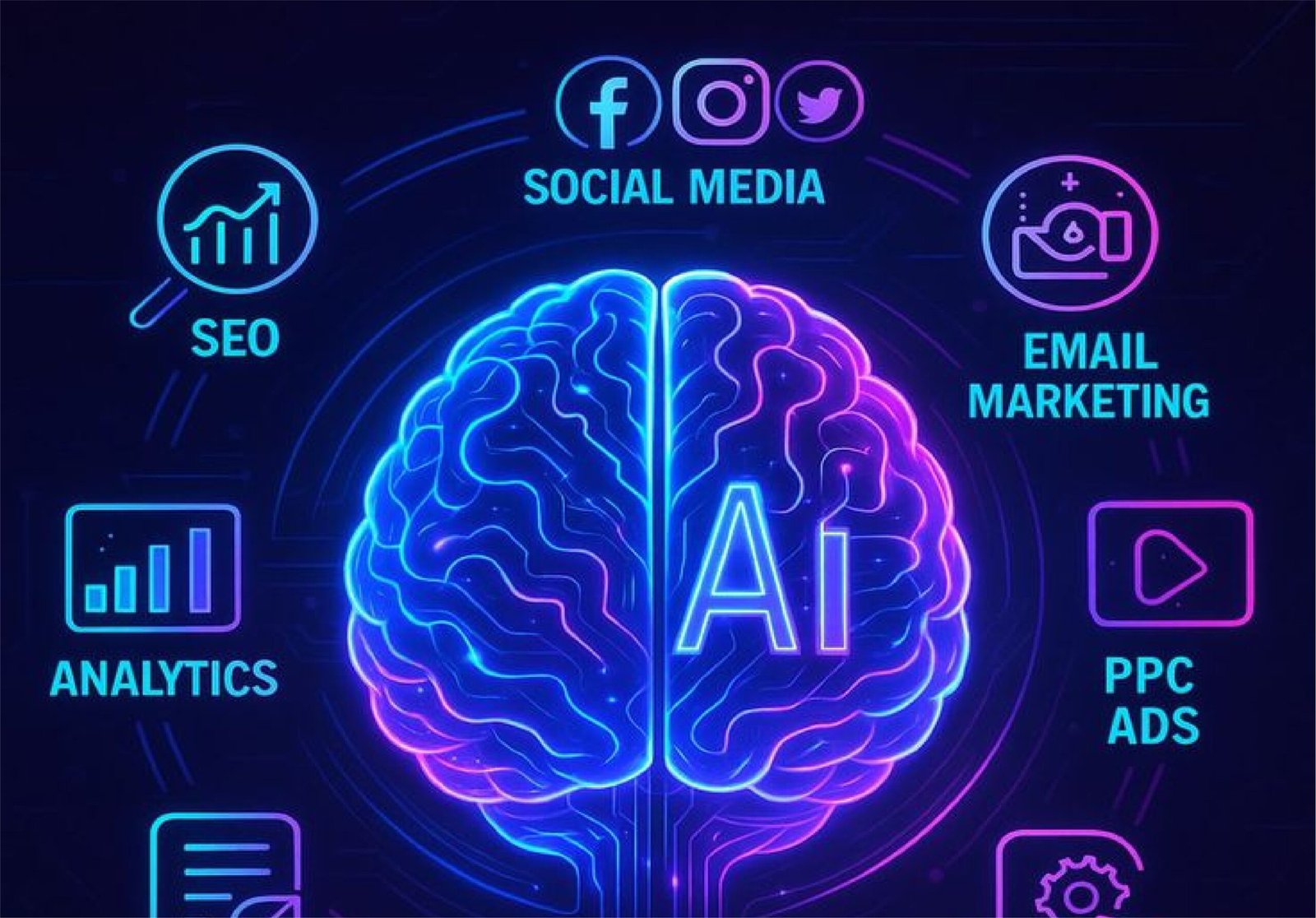
In 2026 artificial intelligence is a must, for marketing teams. They use it to plan, create, analyze and optimize campaigns. Companies that use AI effectively are moving quickly. Achieving good results with AI.
Let’s break down 10 real ways businesses are using AI in digital marketing today with actual use cases you can learn from.
Why AI in Digital Marketing Matters More Than Ever
Before we jump into the list, here’s something important. Marketing has become more complex than ever:
- More platforms
- More content
- More data
- More competition
It is no longer about running ads. You are running funnels, personalization, automation, analytics, and customer journeys simultaneously.
That is where AI-based digital marketing comes in. AI helps businesses:
- save time
- make better decisions
- personalize experiences
- scale faster
And in many cases, it’s doing things humans simply can’t do at scale.
1. AI for Content Creation (With Real Example)
Let’s start with content because this is where most businesses begin. But here’s the difference between theory and reality: Companies are not just “using AI to write blogs.” They’re scaling entire content systems with it.
For example, Hostinger used AI-powered SEO tools to generate and optimize content at scale and reportedly drove over 1 million weekly clicks from organic traffic.
That’s not small.
Another example: marketing teams using tools like Jasper or Surfer are creating multiple variations of blog posts, landing pages, and ads then testing what performs best.
So yes, AI writes content.
But the real win? Speed + testing + scale.
2. AI-Powered Personalization (With Real Example)
AI is particularly useful in the area of personalization. Consider Culture Kings, an eCommerce brand.
They employed AI-based email and SMS segmentation to distribute campaigns to customers in accordance with their behavior rather than distribute the same message across the board.
Result? Better engagement, better targeting, and more efficient campaigns.
The other good example is Bloom and Wild, which predictive AI technology is used to send messages at the appropriate time and not randomly to enhance retention and conversions.
This is what digital marketing and AI actually looks like in action.
3. Predictive Analytics (With Real Example)
Instead of guessing what customers want, companies are now predicting it.
For instance, IBM and Coca-Cola are using AI to analyze data and automate decision-making including marketing campaigns and customer targeting.
And here’s a powerful one: Booking.com uses AI to analyze customer reviews and sentiment helping them improve recommendations and engagement strategies.
So instead of reacting to trends, brands are staying ahead of them.
4. AI Chatbots & Customer Experience (With Real Example)
Chatbots are ubiquitous, but the actual effect is behind the scenes.
Companies are using AI to:
- respond instantly
- qualify leads
- guide users through decisions
Even in industries like automotive, BMW uses AI chat systems to guide potential buyers and answer questions improving the buying experience.
And on the marketing side, platforms like Meta are rolling out AI tools to help millions of businesses automate customer communication and engagement.
That’s scale you simply can’t achieve manually.
5. AI in E-Commerce
Let’s talk about one of the strongest AI use cases: eCommerce. Amazon uses AI to summarize thousands of product reviews into quick insights for buyers.
Think about that.
Instead of reading 500 reviews, a customer gets a clear summary instantly.
That improves:
- user experience
- decision-making
- conversions
And on the backend, Amazon also helps sellers generate product descriptions using AI. That’s full-cycle AI powered digital marketing.
6. AI in Campaign Creativity (With Real Brands)
Big brands are pushing creative boundaries with AI. Companies like:
- Nike
- Coca-Cola
- Heinz
have all launched AI driven digital marketing campaigns that blend human creativity with AI-generated visuals and ideas.
A well-known example is Heinz requesting AI to create images of ketchup, and AI continued to create Heinz-style bottles.
That campaign went viral. Because it wasn’t just AI. It was AI + idea + storytelling.
7. AI in Social Media & Engagement (Real Shift)
Social media is changing fast. Brands now use AI to:
- analyze audience sentiment
- generate captions
- respond to users
But here’s the interesting part: Some companies are even experimenting with AI influencers fully digital personalities that promote products.
Meanwhile, such brands as Aerie are doing the opposite as they refuse to use AI-generated models in order to remain authentic, and it has even increased their sales and brand trust.
So AI is not merely a tool it is influencing brand identity decisions.
8. AI for Marketing Automation (With Real Tools)
Marketing automation isn’t new. But AI is making it smarter.
Tools like:
- Salesforce Einstein GPT
- HubSpot AI agents
- Adobe AI tools
are now helping businesses automate:
- lead nurturing
- campaign creation
- segmentation
For example, Salesforce’s AI (Einstein GPT) connects company data with AI to generate personalized marketing content automatically.
This is where an AI marketing strategy becomes scalable.
9. AI for SEO Growth (Real Example)
SEO used to take months of trial and error. Now AI speeds things up.
Example:
Companies using AI-powered SEO tools (like Surfer or Jasper workflows) have scaled content production massively, with real cases showing huge traffic growth like Hostinger’s million+ clicks weekly.
AI helps with:
- keyword clustering
- content gaps
- optimization
So instead of guessing what works, you follow data.
10. AI as a Competitive Advantage (Big Picture)
This is the reality that most blogs will not reveal to you: AI is no longer an option. It is getting a competitive advantage. Businesses using AI are:
- responding faster
- personalizing better
- scaling campaigns quicker
According to studies, companies already apply AI to minimise manual labour and accurately predict customer behaviour.
That gap between companies using AI and those not using it? It’s getting wider every year.
Final Note
If you look at all these examples, one thing becomes clear: AI isn’t replacing marketing. It’s upgrading it.
The companies winning in 2026 aren’t the ones using AI blindly. They’re the ones using it strategically.
And if you’re building systems, platforms, or campaigns that rely on AI whether it’s automation, personalization, or data-driven marketing working with a team that understands AI based Digital Marketing Services (like Cognitive IT Solutions) makes a huge difference.
Frequently Asked Questions (FAQs)
What are examples of AI in digital marketing?
Among them is Amazon, which applies AI in providing product suggestions, Netflix that provides content recommendations, and Coca-Cola that applies AI in streamlining marketing campaigns and customer intelligence.
Is AI replacing digital marketing?
No, digital marketing is not being replaced by AI. It assists marketers in automation of work and analysis of the data, yet human creativity and strategy are needed.
What are the benefits of AI in digital marketing?
AI assists companies to save on time, enhance targeting, customize client experiences, enhance efficiency and increase ROI.
How to use AI in marketing effectively?
When implementing AI, one should begin with content-generating, email automating, and analytics and continue expanding at a slow pace, integrating AI-collected information and human judgment.