




You open your website analytics dashboard and notice something worrying. Visitors are rushing on your page and exiting almost instantly.
No clicks. No scrolling. No second page.
And this is the question that comes to mind: What is bounce rate, and are you supposed to be worried about it?
Bounce rate is among the first indicators that will inform you whether people really enjoy what they watch on your site, in case you run a web page, blog or an online shop. When the number is large, this does not necessarily indicate a disaster, but it tends to indicate something which requires consideration.
In this guide, we will simplify it, i.e., we will explain what bounce rate is, what is a good number of bounces, why it occurs, and above all the question is how to lower the bounce rate to achieve better SEO and engagement levels.
Let’s get into it.
What Is Bounce Rate?
Bounce rate in simple terms refers to the percentage of visitors who visit one of the pages of your site and leave without looking at any other page.
- They come in.
- They look around briefly.
- Then they exit.
No clicks, no navigation.
Bounce Rate Formula
The following formula is used to calculate the bounce rate: Bounce Rate = (Single-page visits /Total visits)×100.
Example:
- 100 people visit a page
- 25 leave without clicking anything
Bounce rate = 25%
This implies that a quarter of visitors did not engage with the other parts of your website.
Bounce Rate vs Exit Rate
These two are not the same and people tend to confuse them.
Bounce Rate
Someone lands on your page and leaves immediately without visiting another page.
Exit Rate
A visitor gets through several pages on your site and leaves on a particular page.
Example:
- User visits homepage
- Then the blog page
- Then the pricing page
- Leaves
That counts as an exit, not a bounce.
The difference assists you in examining the behaviour of websites better.
What Is a Good Website Bounce Rate?
And now comes the question of what is a good website bounce rate of a website.
This will depend on the nature of the website, traffic, and content. But generally, industry benchmarks look like this:
| Bounce Rate | Interpretation |
| 26% – 40% | Excellent |
| 41% – 55% | Average |
| 56% – 70% | Higher than average |
| 70%+ | Needs investigation |
When people are referring to the average level of bouncing back, we can expect something between 26 percent and 70 percent.
But there’s context.
As an illustration, a blog post, which provides answers to a fast question, may have a higher bounce rate. The answer is read by the user and the job is considered completed.
Conversely, the landing page that is meant to lead to conversions should strive to achieve a low bounce rate.
Ecommerce Average Bounce Rate
The pattern is a bit different in online stores.
The average bounce rate in ecommerce is normally between 20-45 percent, depending on the category of products and source of traffic.
The increasing bounces on ecommerce sites may indicate the following:
- confusing navigation
- slow loading pages
- unclear product descriptions
- poor mobile experience
Given that ecommerce is largely reliant on engagement, it is essential to ensure that the visitors do not leave.
Why Do Websites Get a Higher Bounce Rate?
An increase in bounce rate is not likely to occur without an explanation. There is something that is driving away visitors. These are the most widespread reasons.
1. Slow Website Speed
When the page takes longer than a few seconds to load, a good number of people will just leave.
It has always been established that the delay caused by page load increases the bounce rates heavily. Users want fast websites, particularly on the mobile.
2. Poor Mobile Experience
Over half of the visits to the web are now done on mobile traffic. People will not remain on a site that is difficult to navigate using a phone.
Typical problems include:
- text that requires zooming
- buttons that are hard to tap
- images that load slowly
One of the largest causes of high bounce rates is a bad mobile experience.
3. Misleading Search Results
There are instances when visitors come with a certain expectation and find something totally opposite.
As an example, A page ranking under the best marketing software category and simply defining what marketing software is.
Such a discrepancy results in hasty exits. The SEO requires a match of search intent.
4. Poor Content Structure
Readers can be drowned by gigantic walls of text.
When visitors are not able to scan your content within a short time they tend to abandon the place before they can read anything significant.
Good formatting makes a difference.
5. Too Many Pop-Ups
Pop-ups are useful in conversion, whereas pushy ones may irritate a consumer.
Instant turnover can be caused by full screen interruption, automatic playing of music or too many banners.
The first thing is user experience.
How to Reduce Bounce Rate
And now, the crucial bit, and that is, how to improve bounce rate and retain the visitors.
These are effective measures that can be put into practice.
1. Improve Page Speed
Page speed directly affects bounce rate.
You can improve loading time by:
- compressing images
- using faster hosting
- cutting down on superfluous scripts.
- enabling browser caching
Even a small speed improvement can increase engagement.
2. Make Your Website Mobile-Friendly
Responsive design is no longer the choice.
Your site must be phone and tablet friendly. That involves readable text, optimised images and simplified navigation.
In case users cannot communicate with your page, they will go away.
3. Match Content with Search Intent
Before writing content, ask yourself:
“What is the visitor actually looking for?”
-When somebody seeks a guide, provide him with a guide.
-In case they desire a product comparison, give transparent comparisons.
This cooperation assists in enhancing bounce rate.
4. Improve Content Readability
People scan before they read.
Use:
- short paragraphs
- bullet points
- clear headings
- visuals where needed
The portions of content should be broken down into digestible parts to encourage readers to remain longer.
5. Add Internal Links
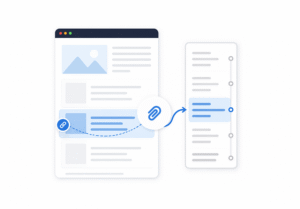
Internal links guide users to explore more of your website.
For example, a reader who is done with an article can be referred to a guide, a case study or a service page.
This automatically minimizes bounce rate.
6. Use Engaging Visual Content
The visual content keeps the users interested.
Images, short videos, and infographics are useful in explaining the information at a speed that is not possible with text alone.
All you need to do is ensure that media files are optimised in a way that they do not slow down your website.
7. Analyse Traffic Sources
Sometimes the problem isn’t the page, it’s the audience.
Social media or paid traffic may tend to have high bounce rates since the individuals access the site with varied expectations.
Analyze your analytics to identify the sources with the highest number of engaged visitors.
Why Bounce Rate Matters for SEO
Bounce rate per se is not a direct factor in Google ranking.
Yet it is user experience, which is of great concern to search engines.
The longer the visitors spend, interact with your site, and navigate through various pages, the better it means that the content is valuable.
That engagement often leads to:
- better rankings
- longer session duration
- higher conversions
In other words, improving bounce rate improves overall site performance.
The Bigger Picture: Bounce Rate Is Just One Signal
Think of bounce rate like a warning light on a car dashboard.
It doesn’t tell you exactly what’s wrong; it just tells you to investigate.
Look at other metrics too:
- time on page
- session duration
- pages per visit
- traffic sources
When you analyse these together, you get the full picture of how people interact with your website.
In Conclusion
Understanding what is bounce rate is the first step toward improving your website’s performance.
Having a high bounce rate is not necessarily an indication of failure. In other cases it just implies that visitors got what they wanted in a short time.
However, when people always abandon it before exploring, then it is worth researching. Improve page speed. Match search intent. Enhance user experience. Produce material that maintains the interest of readers.
And in case you are planning to create a site that optimizes well in search and the visitors are willing to stay longer, Digital Marketing Services can assist in aligning the designs, search engine optimization planning, and user experience.
The slightest increase in engagement can result in large-scale growth in the long term.
Frequently Asked Questions (FAQs)
How to reduce bounce rate in SEO?
In order to minimize the bounce rate in SEO, accelerate your page load, see the content according to the search intention, clear headings, and formatting, and provide internal links that direct a visitor to other helpful pages on your website.
What is a good bounce rate for SEO?
An average typical bounce rate for an SEO will be between 26-40%. Acceptable bounce rates may however change depending on industry, source of traffic and nature of a website.
Is a 70% bounce rate good?
Most websites have a bounce rate that is above 70% bounce rate is above average. It can signify such problems as low-page speed, irrelevance, or poor user experience, but it is normal in some cases of blog pages or informative content.
Is 30% bounce rate good?
Yes, a 30% bounce rate is very good. It usually refers to visitors interacting with your site, browsing via several pages and getting the content interesting.